Why we started Retro Data
Table of Contents
Introduction
We are about to run the Alpha event of Retro Data! This has been almost two years in the making. I thought I would talk about the reasons why it has come together.
Who am I
- I am a data consultant in the UK. I run a small consultancy that helps organisations build data solutions in Azure.
- I also like to contribute to the data community. I have never really stuck to a blog cadence, I have done a handful of (short) talks, but mostly I am involved in organising and helping at events:
- I jointly run DataWeekender .
- I moderate at Data Toboggan .
- I am a 4x SQLBits helper.
- I co-organise Fabric & Power BI Wales .
- I have also helped at Data Relay on the Bristol leg.
Why I wanted to start Retro Data was a consequence of two experiences affected by the constant change in tech, so a bit of background first…
Migrating to Azure Synapse Analytics in 2023
I had wrapped up the migration of a Hadoop data platform into Azure Synapse Analytics at the end of 2022 unaware that Microsoft Fabric would be launched a few months later.
Just after wrapping things up, Microsoft Fabric was announced at Microsoft Build. Almost instantly, all communication related to Azure Synapse Analytics stopped. There were blogs, release notes, a YouTube channel called Synapse Espresso - it all stopped overnight. The last Synapse-related recording was in May 2023 the week before Microsoft Build. Here I was handing over service to the client and all support for the product that had ground to a halt.
Organising DataWeekender in 2023
Towards the end of 2023, we scheduled the 6th edition of DataWeekender. This conference first started in May 2020 and has been a huge success. It has consistently received great feedback from speakers and attendees alike. I joined the committee in 2021 after moderating for earlier events.
We have five organisers, so we aim to run five tracks of content across a single day…a lot of great content! We allocate an organiser per track, then pick a theme for each track. There are some common themes that we try to keep but the tracks might vary based on the number of talks we receive on a give topic, or where the current industry demand is. The main objective is to give a track a common theme so that it reduces the need to flip between tracks. Here is the schedule for DataWeekender 6.5 to give you an idea.
It was my responsibility this time round to curate the sessions so that we could run through the selection process. My first step was to identify a primary topic for the talk based on the product, process, or discipline the talk appears to be covering.
We will then decide the topic for each track based on the distribution of talks. For instance if a third of our talks are about Power BI then we will likely dedicate two tracks to it. We always have a SQL Server track. From there, we will determine a topic for the other two. Once we have set those topics we will run an anonymous evaluations process and pick the best talks for each topic that we have set (with some balancing done along the way). It’s not perfect but wI think we do this pretty well.
Where are the Synapse talks!?
When I did the initial evaluation, this was the distribution of talks…
| Category | Count | Split | Group |
|---|---|---|---|
| AI / ML / Cognitive Services | 8 | 6% | Data |
| Architecture | 15 | 10% | Other |
| Career | 4 | 3% | Other |
| Databricks | 5 | 3% | Data |
| DevOps | 5 | 3% | Other |
| Fabric | 25 | 17% | Data |
| Other | 9 | 6% | Other |
| PowerBI | 49 | 34% | Power BI |
| SQL | 22 | 15% | SQL |
| Synapse | 3 | 2% | Data |
Our call for speakers closed on 30th September - at that point Microsoft Fabric was still a preview product. The only generally available data platform product available on Azure provided by Microsoft was Azure Synapse Analytics…and we had 3 talks submitted! Conversely we had 27 for Microsoft Fabric - more that we got for the trusty SQL Server!
Whilst we need to have sessions to showcase upcoming features, the total drop off of talks on the only generally available data product maintained by Microsoft was incredible.
Not an early adopter
I have to concede that I am not an early adopter of things, that is probably influenced by the regulated industries that my early career started in, and because many of my clients (both in Public Sector and Government) are not early adopters. For example, I am working with one organisation that will only use features that are fully supported.
I therefore observe the effect of this shift in my work - not only did Microsoft stop talking about Azure Synapse Analytics, it felt like the whole of my observable (data) world stopped talking about it too. And sure, maybe Azure Synapse Analytics is 10 racoons in a trenchcoat but those racoons are out there being supported by people who need help and support. It isn’t even the case that these are late adopters or laggards, Fabric was still in preview, a level that Microsoft recommend you don’t use for production use .
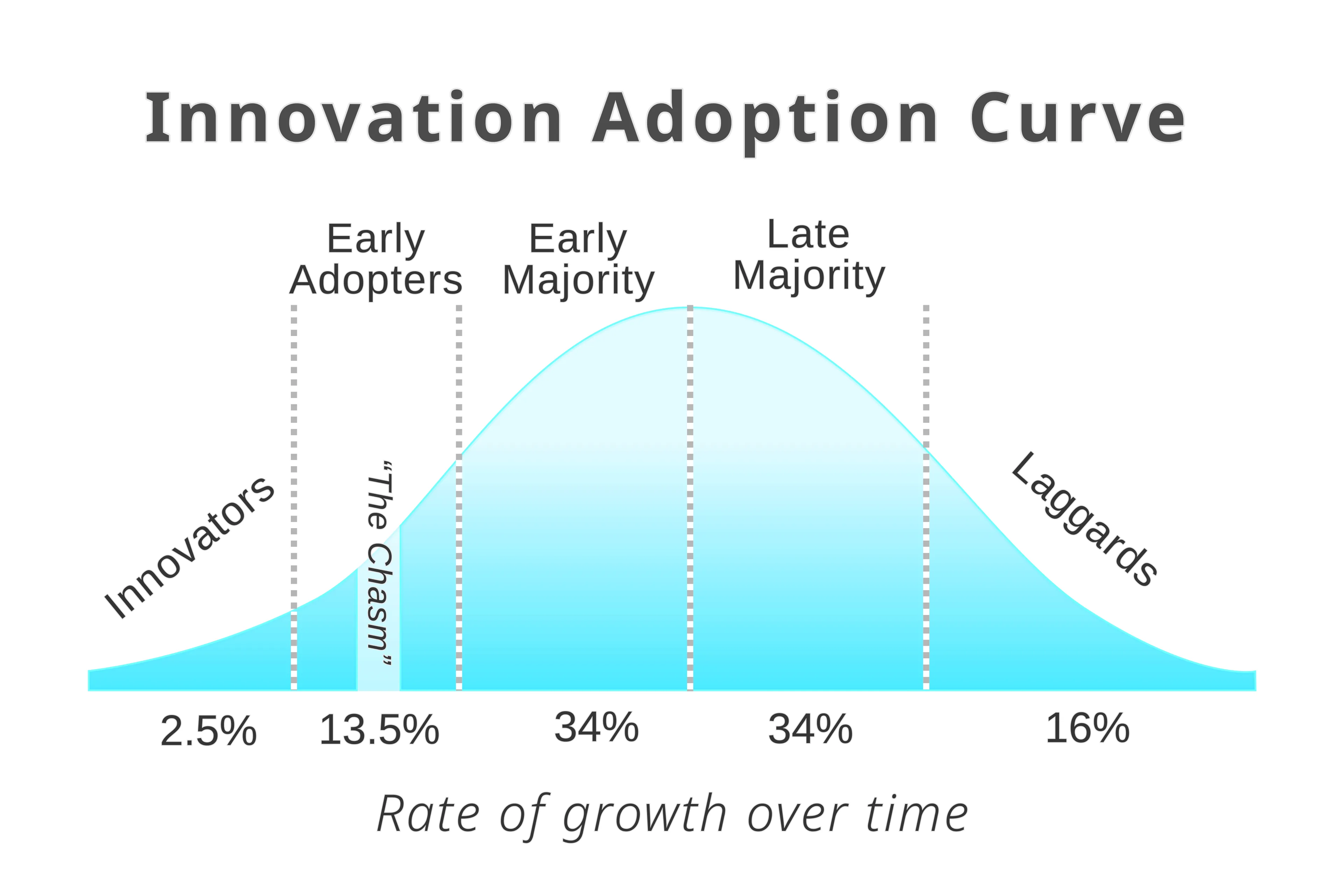 A whole track on Fabric is pointless to bring to the data community because they potentially aren’t going to use it for months if not years. And I expect that a huge amount of the industry is in the same place. Great for Earl E Adopter who wants to get ahead of the curve and work on the bleeding tech, but Steady Eddie isn’t interested in unified analytics, analytics in the age of AI…
The bleeding edge crowds out learning
I attended a talk showcasing a new feature emerging in Microsoft Fabric around this time, and during the wrap up of the session the speaker was quizzed on behaviour of the feature, on how certain widgets would work. To which the speaker responded that this feature probably would change as it is progressed into general availability! The number of people benefitting from a talk for which the feature is subject to change is so limited. I even wonder what benefit it gives the speaker.
I do realise that there is merit in seeing what is in the pipeline, in understanding how things are evolving, or what concepts and features may need to be factored in for future growth. But I feel there does need to be some balance, and if we bring you talks on preview features, we are basically just running marketing for Microsoft and that isn’t why I’m here.
Introducing Retro Data
I was whinging about this at the Code Club I run with some fellow community members, telling them that I wanted a conference that was grounded in practical learning that people can actually take away and apply in their work today. An anti-bleeding-edge conference, and as the ideas got thrown about somebody suggested I could call it Retro Data.
And at that point I knew exactly who would join me on this journey, our very own Retro gamer Andy Cutler .

It has taken a little while for us to get to this point - we have been discussing this on and off for about 18 months! We both have our mainstream conferences that got in the way (Andy is an organiser of Data Toboggan ) and we got as far as setting a date in June this year but life got in the way. Finally now we’re here!
This first event is really a bit of an experiment to see what sort of interest we will get, from both speakers, and audience. We will be bringing you talks that are grounded in practical learning, based on fundamentals that you can apply to your work today. The event be online, with ten talks from industry experts. The talks we have chosen offer content from across the data platform and a range of practical topics for everyone.
Sign up now
We have recently completed our call for speakers, and have announced the schedule for the first event. You can join our meetup group and register for our event on 20/09 where you can also see the schedule.
Linked mentions


#mtfbwy
Comments